

How we work
Caring for nature in Surrey
We are working hard to to reverse nature's decline and restore Surrey's wild places through exemplary land management, expert advice, education and advocacy.
Surrey hosts a stunning mixture of landscapes, yet these spaces face ever increasing pressure from poor management, habitat loss, insensitive development and climate change. Through our work, we aim to ensure a strong collective voice for wildlife both locally and nationally through the Wildlife Trust movement.

We protect wild places
Surrey Wildlife Trust cares for wildlife across 5000ha of land in Surrey, including some of the county's top nature reserves.
The sites under our care include ancient woodlands, vast heathlands, species-rich grasslands and lush wetland. Aided by hundreds of volunteers, we carry out regular conservation tasks to maintain and improve these habitats.
Our key land management partners include Surrey County Council, the Ministry of Defence and The Land Trust. We also work with a range of private landowners to advise them on managing their own sites for wildlife.
Jon Hawkins

© Jon Hawkins - Surrey Hills Photography
© Surrey Wildlife Trust
We use conservation grazing
We use conservation grazing to manage rare habitats such as heathland and chalk grassland.
Livestock grazing is a sensitive management technique with less disruptive impact than burning or cutting. Animals can also access areas which machinery and people can't.
Grazing with cattle
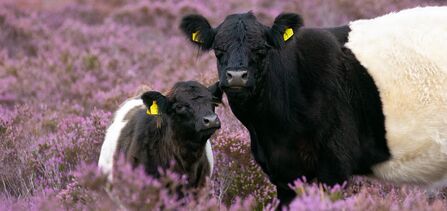
Grazing over 6,000 hectares of heathland and chalk grassland each year, you may encounter our Belted Galloway cows on a number of Trust managed sites.
Through their grazing and trampling, cattle craft a diverse tapestry of terrain, nurturing delicate wildflowers, pollinators, and endangered species, from Nightjars to Sand Lizards, to delicate wildflowers and orchid species.
This lack of uniformity can’t be achieved by machinery or humans. Cattle keep dominant grasses and thatch at bay through their grazing style; they pull and tear with their tongues and trample vegetation, forming different height structures as well as leaving hoof prints which turn into small puddles.
Grazing with Red Deer
Pirbright Ranges is adjacent to a live firing range and owned by the MOD. It is also a wildlife rich heathland habitat.
Access is heavily restricted for safety reasons, which makes it challenging to manage the habitat with conventional techniques. The solution - use red deer, a native species that is ideally suited to the heathland and woodland habitats found on the Ranges.
Although once widespread throughout Surrey, Red Deer in the county are now mostly restricted to deer parks and a few small, wild herds.
The deer help manage levels of pine, birch and gorse on the heath, as well as creating a diverse structure in the regenerating heather. As a result, Nightjar, Woodlark and Dartford Warbler populations are on the increase.
The Trust maintains the herd at around 200 animals and uses special vehicles and camera traps to monitor their welfare.
Grazing with sheep
Why do we graze with sheep?
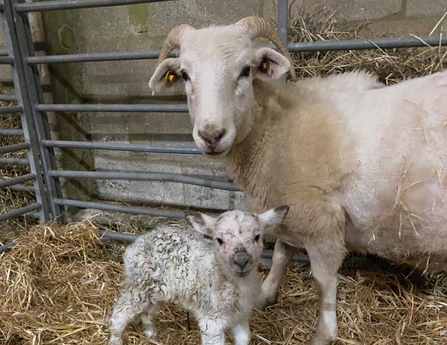
Our Wiltshire Horn sheep support chalk grasslands and wildflower meadows of our east and central Surrey reserves, curbing the growth of the coarse grasses and thatch which threaten to dominate these habitats if left uncut.
The adept browsing of sheep also aids in managing scrub and bramble, further enhancing habitat health. By creating open spaces for less dominant species and regulating nutrient levels, they will help to maintain the delicate balance of the ecosystem.

©Penny Dixie
We work with people & communities
We work with schools, local authorities, landowners, businesses and other organisations to deliver real change on the ground.
We work with local communities, helping everyone to care for wildlife in Surrey through expert advice, education and empowering people and organisations to take action for nature.



We work together as a movement
We are part of The Wildlife Trusts - a federation of 46 Trusts working together to bring back wildlife across the UK.
The Wildlife Trusts is the country's biggest movement for nature. Together, we have over 33,000 volunteers helping us manage 2,600 wild places for nature and for people.