Real horsepower gets the job done

Real horsepower gets the job done

© Surrey Wildlife Trust/Marcus Wehrle

Marcus Wehrle from SWT's Communications team explores how horse-drawn mowing is helping us manage a meadow.

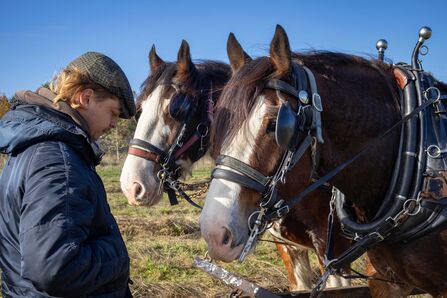
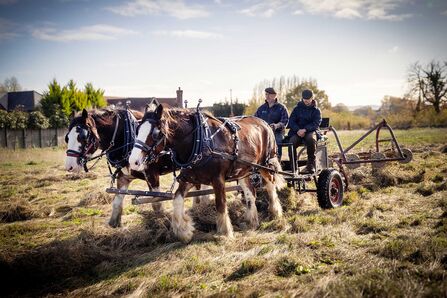
On a chilly November morning I arrived at Oldlands Copse in West Clandon to be greeted by the sight of two magnificent Clydesdale geldings being hitched to a horse-dawn wheel rake. 

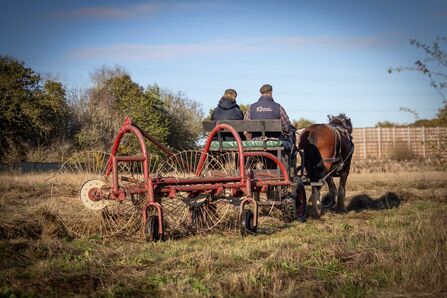
Having already cut the meadow on the nature reserve, today Tom from Oakwood Clydesdales is gathering the cuttings into 'windrows' (lines of hay), to be collected and distributed around the site in small piles to create mini wildlife habitats.

As the horses trotted around the meadow in long circuits with the wheel rake behind them, it was clear to see the benefits of this traditional management technique.

Heavy horses with a light tread 

The horses and light equipment are compacting the soft ground far less than modern machinery, helping to maintain soil structure and maintain drainage. They are also incredibly quiet, with just the soft clanking of the rake and jangle of the tackle, compared to the noise of a motor. This will help reduce disturbance to local wildlife, as well as producing far fewer emissions than a tractor.
Why mow the meadow?

You may wonder why we would bother mowing a wildlife meadow - after all it is not a cricket pitch or recreation ground, so does not need to be kept short.

It all comes down to nutrients. Whilst it may seem logical that a meadow should be nutrient-rich, this is to the disadvantage of many of our delicate native wildflowers. 

You may leave arisings when mowing the lawn to help the grass grow, but we want the opposite. In winter, the dead and rotting stems will boost soil fertility, causing the dominant grasses to outcompete the flowers. By removing these extra nutrients, we are giving them a helping hand in the botanical battle for space, light and pollination.

This in turn will benefit many other species - particularly pollinating insects. Of course we do still want areas of long grass, which are vital for ground-nesting birds such as Skylarks, but it is all about balance.

Keeping traditional practices alive

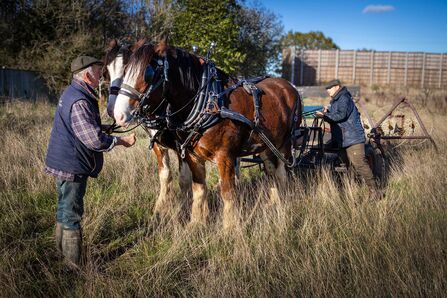
As Tom fed and watered the horses when they had finished in the meadow, he also explained the importance of maintaining traditional agricultural management techniques. The backbone of industry and agriculture for centuries, heavy horse operators are now few and far between, meaning it is vital to support this industry of low-impact land management into the future.